


RealityChuck
-
Posts
3,196 -
Joined
-
Last visited
Content Type
Profiles
New York Mets News, Rumors & Analysis
New York Mets Videos
2026 New York Mets Top Prospect Rankings
New York Mets Trade & Free Agent Rumors
New York Mets Fan Guides & Resources
2026 New York Mets Draft Picks & Signing Bonuses
Forums
Blogs
Events
Store
Downloads
Gallery
Everything posted by RealityChuck
-
True, but an accordion could always go to the Eye of Argon. (And that's probably the most obscure joke anyone could possibly make.)
-
The next installment: No. 40 Jim Fregosi: All-Star infielder, killer accordion player. Trading Nolan Ryan probably made a lot more sense to fans once this card came out and they learned that Fregosi was a man of many skills. Most of the boyhood cards in the magnificent 1972 set showed the players in their Little League uniforms. Not Fregosi. No, he�s brandishing that massive accordion, ready to burst out a lethal version of �Lady of Spain.� And the crazy thing is the back of the card details Jim youth league exploits and never once mentions his apparent musical skills.Most fans would have agreed that the accordion was a better pitcher than Ryan in 1971. Even fans today: WHIP: 1.586, increasing every year he pitched. K/BB: 1.18, becoming worse every year he pitched. ERA+: 86 0 shutouts, 0 complete games (more important back then). Averaging just over five innings a start. -0.2 WAR
-
Benjamin Grimm wrote: This is one of the reasons I was hoping for Chip Hale. Chip, at least, if things go well, can stick around for 10 or 15 years. How many managers stick around for 10 years? Bobby Cox did, but he's the only Braves manager who ever did. The Dodgers had three (out of thirty), and they're renowned for their long managerial tenures. The Yankees also had three (out of 34), but they were extremely successful on the field. The Reds, Indians and White Sox never had any. Thinking about whether a manager will be around ten years from now is a waste of time in a hiring decision: he won't, and that's that.
-
Films Named After Songs That Appeared Not in the Film
RealityChuck replied to Edgy MD's topic in Film Review Forum
Huh? The central sequence to the movie is a ballet set to the Gershwin song. Here's an excerpt: -
Films Named After Songs That Appeared Not in the Film
RealityChuck replied to Edgy MD's topic in Film Review Forum
I assume you don't mean songs like "Key Largo," which was written about the movie. There's an upcoming Nicholas Cage movie, "Season of the Witch," that might not include the Donovan song. John Carpenter's Dark Star doesn't include the Grateful Dead song it's named for. I'm guessing Carpenter could afford the rights. -
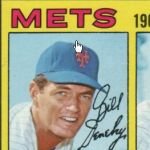
The first Mets card I got:
-
This one, of course.
-
Edgy DC wrote: Chares Radbourn's 1884 used to fascinate me when I was a kid ("his arm was so sore, he couldn't lift his arm up to comb his hair"), but I remember as a kid always understanding that he won a nice, round 60 games that year. Sometime along the road to my adulthood, somebody adjusted the record and subtracted a win from his total. Only, I can't find any record of the record being adjusted, and I'm left to believe either (1) I misremember my childhood, (2) I was a dummy in my childhood, or (3) I'm caught in some kind of W.P. Kinsella psychic time warp where I'm living in the same present as everybody, but remember a different baseall past.According to official records of the time, he won 60. There is one game in dispute. The starter pitched five innings and left with Providence losing by a run. But Providence went ahead the next inning, and Radbourne finished the game without allowing a run. Under the rules of the time, the official scorer gave Radbourne the win because he pitched more effectively. Under current rules, the win goes to the other pitcher and Radbourne gets the save. I say that 60 should be the correct number. Changing the number to 59 is akin to giving Babe Ruth three more home runs because he hit three walk-off hits into the stands that, under the rules of the time, were not scored as home runs. You can't overrule the record book because the rules changed from then to now.
-
Ashie62 wrote: RealityChuck wrote: RealityChuck wrote: Why and how would anyone on the team know? Because they work in close proximity, they're loaded, they're morally vulnerable, and his access to them is golden in the racket he has going. You haven't answered the question. Uh yes he has. Opportunity, access, comraderie, illness, people gamble. Doesn't take much for Samuels to find out who has a sore arm in the clubhouse. Some vulnerable player may know Charlie gambles and asks to use his "agent." Agents tend to show up on Fridays, ask Loduca.That's not what I was asking. Certainly Samuels knew what he was doing, and knew inside information he could use, but why would anyone on the team know he was gambling? Did he put up a sign that says "Place your bets"? Did he say, "I owe a lot to the money to gangsters, so are you feeling bad today?" Did he make calls from a phone in a public place? Assuming Samuels wasn't a complete idiot (and if he were, he would have been discovered immediately), he would not have mentioned anything about betting once he entered the clubhouse. Note that he was suspended as soon as an investigation found evidence. Note, too, that no one has claimed that any of the players made bets. You can be sure that there would have been an immediate suspension -- called for by the Commissioner's office, not the Wilpons -- of any player whose name appeared on the evidence that led to Samuels. Also, people who have gambling problems are good at hiding it. I've seen it happen before -- someone who you'd never suspect turns out to be deeply in debt for gambling and breaks the law to finance his habit. But they never come out and say, "I like to be a lot" of give outsiders -- even their own family -- clues about what they are doing until things crash down. I knew someone who got in trouble for gambling, and no one who knew him even suspected he was gambling at all. He never talked about betting and never showed the slightest interest in horse racing until it was discovered he was using the company credit card to pay for his losses on an OTB Phone Betting account. I have no doubt that Samuels could have been equally adept at keeping people in the dark. So how would anyone know he was betting or having a gambling problem?
-
Edgy DC wrote: RealityChuck wrote: Why and how would anyone on the team know? Because they work in close proximity, they're loaded, they're morally vulnerable, and his access to them is golden in the racket he has going. You haven't answered the question.
-
Why and how would anyone on the team know?
-
Former San Francisco Giants Who've Never Won a Championship
RealityChuck replied to a topic in New York Mets Talk
Mike McCormick (1956-62, 1966-1970) Cy Young Award winner. -
What about Presley? Or, for that matter, Costello?
-
1. Davis 2. Thole 3. Niese 4. Takahashi 5. Carter It's been a long while since we had five rookies who could be given serious consideration for such an award.
-
This, of course, applies to the revised version (which is the only one most people have seen). The original had far less Bogart/Bacall interplay (no scene where they discuss "horse racing," for instance), though the plot made much more sense.
-
Star Wars: Episode IV - A New Hope (1977)
RealityChuck replied to metirish's topic in Film Review Forum
Great film. The only downside is it marked the beginning of the end for films for adults and intelligent science fiction. But that's not entirely the fault of the film and it still holds up very well. -
Well, if it's an accusation that is pointless to deny, I won't deny it. I'll just leave it as self-evidently absurd.It's not absurd -- it's an issue that historians have to wrestle with all the time: making sure they don't bring their own preconceptions into their analysis. Here's an example: In the book, The Telephone Gambit, author Seth Shulman was struck by the similarity between Bell's drawing of the telephone microphone and that of a drawing in Elisha Gray's patent application. He took that as evidence that the Bell patent was stolen. But when he first mentioned it, a colleague asked, "How do you know that this just isn't a standard way of portraying things that hundreds of inventors used?" And he was right: if no one else did a drawing like this, it's one thing; if everyone else did, it's something else. You can't draw any conclusions until you establish this point. I've seen the same thinking right here on the board: the question was asked "Why did Casey Stengel talk about Ed Kranepool as a leadoff hitter?" Now, part of the answer is that Casey would often say things just to entertain the press. But the other part is that back in 1963, managers evaluated the batting order differently. Kranepool didn't have the OBA or the speed to be a leadoff hitter -- today. But Casey didn't look at OBA, and speed was not thought particularly important back in 1963.* Asking the question requires the assumption that Casey was looking at things the way we do now. But the person asking the question never considered this and was huffy when I pointed it out. As usual, he denied he was making the assumption that was obvious in the question. I've seen that behavior many a time. It's one of the hardest things in the world to question your own ingrained assumptions, yet it's something that has to be done when trying to analyze the past. So, when you're discussing Hitchcock's relation with his leading ladies, you need to view it within the context of his times and background. Things that are not acceptable today were perfectly acceptable back then (and things unacceptable back then are perfectly acceptable now). The comments in the article are similar to him condemning Hitchcock because he allowed cigarette smoking on the set. He's putting everything in a 21st century context, but that doesn't apply to things that happened 50 years ago. *Maury Wills excepted -- his 102 the year before was considered a fluke, though teams were seeing they were useful. Casey, however, was certainly going to be old school on the subject since only had one player who topped 20 with the Yankees -- Mickey Mantle, who didn't bat leadoff (and that was in 1959, one of the few years they didn't win the pennant). Phil Ruzutto topped 15 three times during that stretch, but the team never had more than one player over ten, and some years none reached ten. So it was not surprising that Casey wouldn't think SBs meant all that much.
-
Yes. Or, rather, he assumes that all the people involved in making Hitchcock's movies were living in 2010 and thus their behavior has to conform to current norms. It's a very common fallacy. No one is immune to it, and, of course, people are so blind to it that they deny they're doing it.
-
Off-set, Hitchcock had a penchant for practical jokes, and often played them on his female actresses (though he did them with the men, too, when is suited him). There is, of course, a lot of blatant presentism in the assumptions of the article; the writer assumes (without realizing it) that Hitchcock was living in 2010 when he was making his films (and, of course, will deny that -- presentism is always blind to itself). You can also pick and choose. Hitchcock's women were more often than not smart, self-assured, and very competent. There's Edna in the original The Man Who Knew Too Much (a crack shot with a gun and the only one with the nerve to take out the villain), Miss Froy in the Lady Vanishes, Sylvia in Sabotage, Charlie in Shadow of a Doubt, Connie Porter in Lifeboat, Lisa in Rear Window (as well as Stella, in a different way), Eve in North by Northwest, Blanche in Family Plot, and others. So by choosing those examples, you could argue that Hitch was a feminist.
-
Oh, and Hitchcock's penchant for putting women in danger is due to story needs, not any dark psychological demons. His films were always about suspense, and you can't have suspense without danger. And a damsel in distress is far more dramatic than a man in trouble (and Hitchcock had plenty of them, too -- Cary Grant in North by Northwest, Robert Cummings in Saboteur, Montgomery Clift in I Confess, Henry Fonda in The Wrong Man, etc.).
-
I've long enjoyed Joe Queenan's take on Alfred, which was pretty much that he was as good a flimmaker as one can be without being great. Or (re-reading), he is great, but not great-great. Pretty good work by Queenan from back when his snark content was about 40% instead of the 80-85% it runs at now that he's a brand name. He had me until this: Carole Lombard was given a dry run in Mr. and Mrs. Smith, but she must not have been docile enough, because Hitchcock never used her again, and so she was forced to move on to more fertile fields. Because she was dead, maybe? Mr and Mrs. Smith was her next to last film before she died in a plane crash.
-
Vic Sage wrote: Benjamin Grimm wrote: Not sure exactly why, but I have a special fondness for Shadow of a Doubt. maybe cuz its really good? It was Hitch's own fave of his films, apparently.I think Hitch liked it for reasons other than than what was on the screen (most notably, having Thornton Wilder involved). It's second-tier Hitchcock -- good film, but not one of his greats. I'd say his great films are North by Northwest, Psycho, Notorious, Rear Window, The 39 Steps and Strangers on a Train. Second tier are Shadow of a Doubt, The Lady Vanishes, Saboteur, Family Plot (very underrated), The Man Who Knew Too Much (both versions) and Young and Innocent There are also plenty of good films that don't make either of these lists.
-
Hard to choose, but I went with North by Northwest. Rear Window, Strangers on a Train, The 39 Steps and Psycho are also in the running. I do find Vertigo overrated. Re the psychiatrist in Psycho: his explanation was never supposed to explain anything. It was put there so those who needed an explanation would have one.
-
What? No Ollie?
-
There are very few really good catchers today, and even fewer that could be available. Thole should be the starter next year and for years to come. As for power, that's just trying to put the square pegs of sabremetrics into the round holes of reality. No position is "supposed" to be a power position -- some just tend that way. But the key is that you get the power from somewhere in the lineup, not from a particular position.
