


RealityChuck
-
Posts
3,196 -
Joined
-
Last visited
Content Type
Profiles
New York Mets News, Rumors & Analysis
New York Mets Videos
2026 New York Mets Top Prospect Rankings
New York Mets Trade & Free Agent Rumors
New York Mets Fan Guides & Resources
2026 New York Mets Draft Picks & Signing Bonuses
Forums
Blogs
Events
Store
Downloads
Gallery
Everything posted by RealityChuck
-
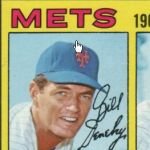
I started collecting seriously in 1961 and kept at it until 1994. Best thing is that I have them all. Tom Seaver's rookie card, for instance, showing Tom and the immortal Bill Dennehy*. Paid about 1 cent for it. I've got a couple of Mets from 1962. No hats, of course. Alas, it's no fun anymore. A baseball card shouldn't be glossy on the back, and having to keep some in a safe deposit box really takes the joy out of it. We did flip cards -- you just called odd or even. Two head or two tails = even. But no one thought they were valuable. Best example: You would often have special rookie cards that had two players from different teams. At the time, my brother kept his cards organized by team. So for these, he'd split the card -- peel the front from the back, then cut the card in half and paste it to card stock. So you would have the player's picture on one side of the card stock, and his stats on the other. I have a Rod Carew rookie card that was treated this way. (Luckily, I also have an intact version.) *Best known for being traded to Washington so Gil Hodges could manage the Mets.
-
Better than I expected, but not much more than average. In today's dire climate for comedy, it certainly stands out, but there are hundreds of funnier movies.
-
Meaningless. PECOTA is just masturbating with numbers.
-
="Bret Sabermetric"]She had plenty of money and was (supposedly) willing to spend it to improve her team. This might seem obvious, but it was far from true of every teams' owners, some of whom did not have money to spend, and some of whom saw their teams as more of a pure business than Mrs. Payson, who really loved the team, ever did. Bill Veeck, for example, reallly loved his White Sox but just didn't have the scratch to support them properly---he was always arranging for financing deals that Mrs. Payson never had to think about. She was also elderly, which motivates owners to spend more freely over the short haul.Ah, yes, a textbook example of Rothman's First Law of History: The hardest thing to understand is that people in the past thought differently than we did. You are using 2006 assumptions to criticize the mindset of those in the 1960s. And the biggest internalized assumption guiding your entire criticism is this: you're assuming there was free agency in 1965. Your entire argument assumes this. There wasn't. And signing bonuses were rare (the days of the Bonus Baby were past). A team would go out, scout a player and sign him to a contract. Nearly all the time, the player would go with the first team to sign him. How much of a bonus did the Mets pay Nolan Ryan? Jerry Koosman? Ed Kranepool? How much was paid to any of the 1969 team, other than Seaver? But even spending money on signing bonuses was no guarantee that the player would ever amount to anything (this is why the days of the Bonus Baby were over before the Mets came into existence). You built a team by scouting and good trades back then. (IIRC, Tom Yawkey spent at least as much money on his team in the 50s as Dan Topping did, but it didn't help him.) A player's salary was determined by the GM's whim -- and giving him a big raise did nothing to improve his ability. Many players before free agency hated their GMs, because it was the GM's job to lowball the player, and the GM had all the clout. Nowadays, you can buy the players you want, and contracts are often a factor in why a player is traded. Money makes a difference. But not in the 60s. Long-term contracts were rare, and the player had no choice but to take your offer. Money was hardly ever a factor in trades. Until you stop unconsciously assuming there were free agents in the 60s, you can't judge the situation properly. It really didn't matter if Weiss was cheap (he was cheap at the Yankees, too, wasn't he?).
-
Yancy Street Gang wrote: Keeping it in the family: Ed Kranepool played with Alex Trevino for the 1979 Mets. Alex Trevino played with John Franco for the 1990 New York Mets John Franco played with David Wright for the 2004 New York MetsThanks. That links every player from 1962 to every player on the current roster (except for those who did not play for the Mets last year), all without leaving the Mets.
-
1962 --> 2006 ] Chris Cannizzaro played with Dave Roberts for the 1970 San Diego Padres Dave Roberts played with Jesse Orosco for the 1981 New York Mets Jesse Orosco played with Paul Lo Duca for the 2002 Los Angeles Dodgers ] Marv Throneberry played with Boog Powell for the 1961 Baltimore Orioles Boog Powell played with Alfredo Griffin for the 1976 Cleveland Indians Alfredo Griffin played with Carlos Delgado for the 1993 Toronto Blue Jays ] Charlie Neal played with Pete Rose for the 1963 Cincinnati Reds Pete Rose played with John Franco for the 1986 Cincinnati Reds John Franco played with Kazuo Matsui for the 2004 New York Mets ] Felix Mantilla played with Warren Spahn for the 1958 Milwaukee Braves Warren Spahn played with Phil Niekro for the 1964 Milwaukee Braves Phil Niekro played with Jay Bell for the 1987 Cleveland Indians Jay Bell played with Jose Reyes for the 2003 New York Mets ] Elio Chacon played with Bill Henry for the 1961 Cincinnati Reds Bill Henry played with Tony Perez for the 1964 Cincinnati Reds Tony Perez played with John Franco for the 1986 Cincinnati Reds John Franco played with David Wright for the 2004 New York Mets ] Frank Thomas played with Grant Jackson for the 1965 Philadelphia Phillies Grant Jackson played with Dennis Martinez for the 1976 Baltimore Orioles Dennis Martinez played with Cliff Floyd for the 1993 Montreal Expos ] Jim Hickman played with Don Sutton for the 1967 Los Angeles Dodgers Don Sutton played with Tim Belcher for the 1988 Los Angeles Dodgers Tim Belcher played with Carlos Beltran for the 1998 Kansas City Royals ] Richie Ashburn played with Stu Miller for the 1956 Philadelphia Phillies Stu Miller played with Phil Niekro for the 1968 Atlanta Braves Phil Niekro played with Tom Glavine for the 1987 Atlanta Braves Tom Glavine played with Victor Diaz for the 2005 New York Mets (or) ]Richie Ashburn played with Ed Kranepool for the 1962 New York Mets Ed Kranepool played with Jesse Orosco for the 1979 New York Mets Jesse Orosco played with Xavier Nady for the 2003 San Diego Padres ] Jay Hook played with Frank Robinson for the 1958 Cincinnati Redlegs Frank Robinson played with Dennis Eckersley for the 1976 Cleveland Indians Dennis Eckersley played with Pedro Martinez for the 1998 Boston Red Sox ] Roger Craig played with Stan Williams for the 1958 Los Angeles Dodgers Stan Williams played with Ted Simmons for the 1971 St. Louis Cardinals Ted Simmons played with Tom Glavine for the 1988 Atlanta Braves ]Craig Anderson played with Felix Mantilla for the 1962 New York Mets Felix Mantilla played with Bob Watson for the 1966 Houston Astros Bob Watson played with Craig McMurtry for the 1983 Atlanta Braves Craig McMurtry played with Billy Wagner for the 1995 Houston Astros
-
No opinion, because it's too early to tell. Some have considered it potentially a pretty good trade. (http://tinyurl.com/ds5ev) It's a gamble, but not an outrageous one.
-
Vic Sage wrote: In order to sign big $ FAs (Martinez, Beltran, Wagner), Freddie Morebucks makes Omar dump salary. Because god forbid we should have a payroll commensurate with our marketplace. So we trade Cameron away for Nady,And the fact that Cameron demanded the trade has nothing to do with it? ]and Benson for Julio,And Benson being ineffective wasn't a factor? ]and we trade for LoDuca because he'll be cheaper than Hernandez or Molina (so he thought)And just as good. So why is that bad? ]The Delgado deal was basically a FA signing, a year late, that cost us top prospects.A FA who flat out refused to sign with the Mets, even though they gave him a better offer than the Marlins. How is missing that Moreno's fault? ]Now he's trying to move Matsui and as much of his $$ as possible, in order to play... who? Keppinger? Anderson? Does that really make us better at 2b, or is it just a matter of reducing our expenses at that position (e.g., even if we only move $2m of matsui's deal, Keppinger makes the minimum)?That depends on who they get for him, doesn't it? ]We need another frontline SPer, and we need one now. And we need one without giving up Milledge. Anybody else is expendable.Yes, let's rub our magic lamp and he'll appear. It's oh so easy to pick up a frontline starting player without giving up anything in return. Other GMs are happy to give up starting players if you ask them nicely.
-
Rating 1-5 5=great I left off those I had no opinion about. New York Mets released Bobby Bonilla. 5, 5 New York Mets traded Masato Yoshii to the Colorado Rockies for Bobby Jones and Lariel Gonzalez. 4 (only because it gave us two Bobby Joneses), 3New York Mets traded Luis Lopez to the Milwaukee Brewers for Bill Pulsipher. 0 New York Mets signed free agent Timo Perez. 0,3 New York Mets traded Jesse Orosco to the St. Louis Cardinals for Joe McEwing. 0,2 New York Mets released Rickey Henderson. 5,5 New York Mets traded Bill Pulsipher to the Arizona Diamondbacks for Lenny Harris. 0,3 New York Mets traded Melvin Mora, Mike Kinkade, Pat Gorman and Lesli Brea to the Baltimore Orioles for Mike Bordick. 5,5 Gave up a lot, but the team needed a shortstop, and without it, they'd probably no have made the post season Colorado Rockies signed Mike Hampton of the New York Mets as a free agent. 1,2 Hated losing our ace, but he didn't do all that much after we lost him. New York Mets signed free agent Kevin Appier of the Oakland Athletics. 3,2 New York Mets signed free agent Tsuyoshi Shinjo. 0,2 New York Mets traded Bubba Trammell to the San Diego Padres for Donne Wall. 0,1 Big mistake. New York Mets signed free agent Steve Trachsel of the Toronto Blue Jays. 0,5 One of the team's better moves. Baltimore Orioles signed Mike Bordick of the New York Mets as a free agent. 2,2 Matt Franco granted free agency. 2,1
-
Vic Sage wrote: THE WILD PARROTS OF TELEGRAPH HILL are not listed as an eligible release in 2005: http://www.oscars.org/78academyawards/reminder/reminder_html.html perhaps it was released in 2004?Hard to say. The IMDB says it was first shown at film festivals in 2003 and 2004, but its first general release was in February of 2005. The IMDB does not indicate it was shown in LA prior to the general release, but it is possible there was a one-week run in 2004 to make it Oscar eligible. In any case, it was in very limited release before 2005, so it is a 2005 film to the general public..
-
I've missed a lot (I don't often to to theaters), but here are my choices: 1. Crash 2. Wallace and Gromit in The Curse of the Were-Rabbit 3. The Wild Parrots of Telegraph Hill 4. Batman Begins 5. Good Night and Good Luck 6. Me and You and Everyone I Know 7. March of the Penguins 8. Kung Fu Hustle What are yours?
-
Bret Sabermetric wrote: Can't you guys keep out of this crazy mixed-up world of "tangible reality," as you call it, for five minutes? Can we please get back to my world of hypotheticals that exists only in our imaginations? Jeez. OK. In hypotheticals, you play whichever player is better. Or, to be more precise, whoever is more likely to help the team. You can also determine whether you need help in the long run or the present. Salary should not be a factor in the decision.
-
It's a silly question, because it all depends on the vet and the kid. The only real way to look at the question is to ignore the issue of salary and ask yourself, "if both men were paid the same, who would you play?" You're paying for the vet whether he plays or sits, so if the kid is more worthy of play, then the vet sits or is traded. Now, you may want to play the vet to increase his trade value. But, given a real-world situation -- Matsui, for instance -- there is nothing wrong with playing someone like Kepplinger and having Matsui sit. It doesn't cost you anything more than the reverse, does it?
-
I rate movies on a scale of 1-10. It's a combination of the quality of the film and its emotional power. I do tend to rate on the upper end of the scale, but that's because I avoid any films I think would be a 5 or below.
-
Kane deserves its reputation. I think the best evidence of this is just how fascinating the film is. I once caught it on TV just a week after I had seen it in a theater. Despite that, I found it impossible to change the channel. The story is just so good. And, yes, there are plenty of innovation. The camera going through the glass skylight, for instance. The shots framed to show a ceiling (considered bad form until Welles did it). The entire film is a visual treat and even the things like deep focus (which had been used before) were never used to such effect, and showed filmmakers new ways to use what they had. A great film by any standard.
-
Top 10 submarine war movies to see: BEDFORD INCIDENT DAS BOOT Nice choice, but "The Bedford Incident" was set on a destroyer, not a sub (Though there was a Russian sub in it). Das Boot is probably the best submarine movie out there (well, technically, it was a TV miniseries cut down to feature length). It was pretty daring for showing everything from the German point of view, and some of the scenes are the perfect definition of "suspense."
-
Philospohical Discussion - How Long Do You Wait?
RealityChuck replied to MFS62's topic in New York Mets Talk
And why does this matter? -
Saw it on DVD yesterday. It was a nice adaptation of the book, though the Daddy Wonka subplot was completely unecessary and added nothing to the story.Roald Dahl has always been well served in film.
-
why is it most players perform better at home?
RealityChuck replied to a topic in New York Mets Talk
All of the above. It's a combination of factors, and they affect different players differently. There are also differences in other sports. ]1) mm's 'friendly fans" thesis It definitely better if the fans are rooting for you. Not only does it encourage the home team, it discourages the visitors and may affect the officials (though probably not so much). Not all players are affected, but there are always one or two on a team who get upset by it (do you really think the booing doesn't affect Matsui, for instance? If it doesn't why does anyone boo him?), and that's often enough to make a difference. ]2) nymr83's thesis, expressed in the thread referenced above that the players are better rested for sleeping in their own beds. It's generally better to sleep at home -- not to mention that you haven't been traveling to get to the city where the hotel is. Travel is tiring. Again, this doesn't have to affect the entire time; all you need is for one or two key players to be off just a bit, turning a home run into a long fly ball, for instance. ]3) James mentioned the idea that the umpires are under some pressure, psychological or otherwise, to get the vocal dissatisfaction down to an acceptable level and so favor the home team on close calls. Least likely -- umps might just as easily favor the visitors because they're pissed at the fans. And most officials make the call in a split second, without thinking about how anyone will react. ]4) He also put forth the notion that in baseball the advantage is strategic: the home team gets to bat last and so can apply strategies suitab le for its needs. Certainly. If the score is tied in the bottom of the ninth, all the home team has to do is score. If the score is tied in the top of the ninth, the visitors may go ahead, but the game isn't over. ]5) James, too: familiarity with the physical quirks of the home field is an edge True. And it also works in other sports. The Celtics used to be great in Boston Garden because the floor had both dead spots and live spots and a Celtic player could manuever an opponent to dribble onto the dead spot and steal the ball. ]6) nymr83 also mentioned his hope that the GMs have acquired players whose skills suit the home park--this may be the same as or different from number 5). Different, but of course you're going to get players who have the right skills for your park. The Red Sox aren't going to want a left-handed fly-ball pitcher, for instance. Less of a factor in other sports, though there are differences in parks. Remember: hockey rinks and basketball courts have only been standardized sizes relatively recently. ]odd that baseball is the only game that has distinct and tangible advantages to being home (hitting last, unique fields)Don't forget hockey does, too: the home team always gets the final line change, so they can react to the visitors and have the most effective matchups. Ultimately, it's a multivariable problem dealing with human emotions, which means you can't prove anything one thing is the cause. -
Good movie, but not great, and not even Brooks's best. It also dates badly.
-
]By definition, the players who meet the above criterion are singles hitters who only walk on occasion and rarely slug home runs. Clearly, that's the issue. If that's your definition of overrated, fine. It's not mine and it really looks at the issue with tunnel vision (one of the two main pitfalls of all statistical analysis, the other being the issue of factors that don't show up in the box score).
-
My top ten since 1960 (in no particular order): Moulin Rouge Chicago Cabaret How to Succeed in Business Without Really Trying Everyone Says I Love You (unjustly underrated masterpiece) Little Shop of Horrors A Hard Day's Night definitely a musical (and Help! is even more so), not a music film My Fair Lady West Side Story South Park -- Bigger Longer and Uncut (One of the few true animated musicals with a Broadway sensibility -- Beauty and the Beast is the other.)
-
Suit yourself. But you're comparing "more of the same" to "groundbreaking," and the sequel just didn't have the impact the original did.
-
Star Wars had the Deathstar, the opening shot, the cantina, the entire new universe, the 1930s serial updated. Empire was just riffing on the same themes. Not bad, but far less creative and dramatic.
-
mlbaseballtalk wrote: Opinion: The Mets of the Payson years loved to get Mets with ties to both the Dodgers and Giants Fact: The very first official (MLB or Mets) release of a complete NY Mets baseball game on DVD is Game 5 of the 2000 WS as part of the MFY Fall Classics 1996-2001 Box Set Opinions: That's not much of a choice from a Mets point of view. Fact: The last New York Giant and the last Brooklyn Dodger playing in the majors both finished up their playing careers with the Mets. (Willie Mays and Bob Aspromonte, respectively).
