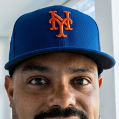
Yirsandy Rodríguez Grand Central Contributor Posted 11 hours ago Posted 11 hours ago As is usually the case for a rookie, it was a season of challenges and lessons for A.J. Ewing and, if I had to choose a breakout player for the New York Mets from 2026, I would go with him. I love Carson Benge and enjoyed his season from Opening Day onward, but we had much higher expectations for what he would be capable of doing with his tools given his history as one of the top prospects in the organization. In contrast, Ewing began the 2026 season with the Binghamton Rumble Ponies, the Double-A team. There, he hit .349 (22-for-63), with two home runs, six doubles, one triple, seven RBIs, 16 runs scored, 17 walks, 12 stolen bases, a .481 OBP, and a .571 slugging percentage in 18 games. He was then promoted to Triple-A Syracuse on April 27, and his bat continued to produce, as he posted a .326/.392/.435 slash line, with three doubles, one triple, four RBIs, nine runs scored, and five stolen bases in 12 games with the Syracuse Mets. His performance earned him a spot on the MLB roster on May 12. His debut at just 21 years old generated a lot of excitement because of the way he burst onto the scene at a time when the team was still trying to find its rhythm. He went 1-for-2 with a triple, two RBIs, three walks, two runs scored, and one stolen base in his major-league debut on May 12 against the Detroit Tigers. That performance made him the first Mets player to hit a triple in his debut, joining Leroy Stanton (9/28/1970), Eric Cammack (7/5/00), and Marco Scutaro (7/22/02) as the only Mets players to smack a triple as their first career hit. The three walks he drew—including one that drove in a run with the bases loaded in the eighth inning—also made franchise history for a debut. From that point forward, Ewing showed his ability to handle big situations and succeed with several of his main tools, such as his speed, his ability to play elite defense in center field, and his contact ability, which looked much better when we analyze his expected stats. Throughout the season, it was reasonable to expect a little anxiety at the plate as Ewing got used to playing every day and the league began attacking him in his weaker areas, such as his struggles against sliders and changeups, which were exposed all the time. However, his identity as a hitter did not change much, and that is one of the most interesting aspects of his season looking ahead. Ewing stayed true to his plan and did not even fall apart during his worst moments. He continued to control his aggression, which is not very common among such young hitters facing baseball’s highest level. He finished in the 69th percentile in chase rate, the 52nd percentile in walk rate, and the 59th percentile in hard-hit rate, three metrics in which he was more stable than Benge. Here, we can see some interesting differences between the two players, as Benge was much more consistent at hitting the ball and, in general, was a more complete player in every aspect of the game. I am not looking at this as a comparison simply to find out who is better, because it is clear that Benge had the better rookie season. However, if you look at all the different metrics, the differences between them are not that far apart. Benge had a greater offensive impact, but I feel that if Ewing can work on improving his contact and maintain the quality of his balls in play, the difference we are seeing in their expected stats could favor him a little more. One of Ewing’s biggest problems was strikeouts, and 49.8% of them came against pitches that were not fastballs. Although he struggled against fastballs in the upper third of the strike zone (he swung under them with troubling frequency) Ewing averaged a .286 xBA against fastballs. In contrast, breaking balls and changeups were a lethal combination and left him with a 36.2% whiff rate and just a .218 xBA. As for baserunning and defense, both Benge and Ewing performed at a high level, with just two interesting differences. Benge showed incredible arm strength, but Ewing was much better in OAA and finished in the 94th percentile in sprint speed, leaving Benge (82nd percentile) in the dust. Ewing also knew how to use his speed to become a threat on the bases. He led all rookies with 25 stolen bases and set the franchise record for a rookie, surpassing the previous mark of 24 set by Mookie Wilson in 1981. Both Benge and Ewing were fun to watch, and the most interesting thing is that, in a disastrous season, both were able to make the most of their opportunities and have now become two of the franchise’s most promising figures heading into 2027. Image courtesy of Vincent Carchietta-Imagn Images View full article
Recommended Posts
Create an account or sign in to comment
You need to be a member in order to leave a comment
Create an account
Sign up for a new account in our community. It's easy!
Register a new accountSign in
Already have an account? Sign in here.
Sign In Now