


Mets Video
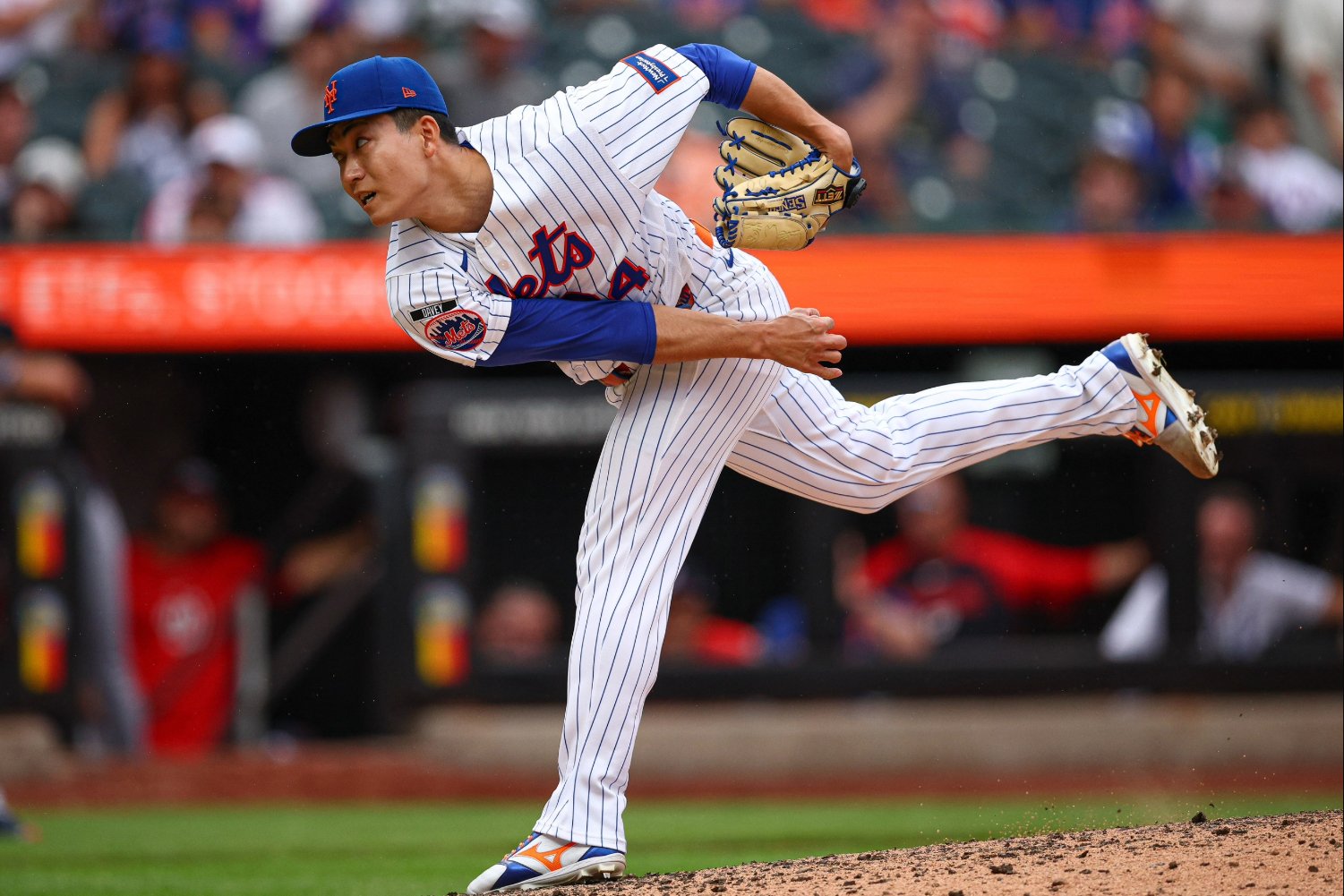
Despite surrendering a walk-off home run to Tristan Peters, Kodai Senga’s transition to a single-inning reliever has been far more fruitful than this season’s work out of the rotation. Since making the switch on August 4, Senga has featured eight times, thrown 7.1 innings, and posted a 2.45 ERA. It’s a small sample, but it stands in stark contrast to the 8.66 ERA he managed over his prior 44.2 innings of work.
Now, with Devin Williams on the injured list due to a shoulder strain, Senga is the New York Mets' de facto closer, and his relative success has piqued fans' interest. Could Senga be the Mets’ answer at closer in 2027? Perhaps he’s this generation’s Koji Uehara? Or is this stellar run a small sample blip? Oh, and as for Devin Williams, cue the Simple Minds.
The biggest obstacle to Senga closing in 2027 is himself. It wasn’t that long ago that he was a legitimate starting pitcher. In 2023, his rookie season, he ghost-forked his way to a 2.98 ERA over 166.1 innings, finishing second in Rookie of the Year voting and seventh in the NL Cy Young. His follow-up campaign was derailed by injury, but in 2025, he posted a 3.02 ERA over 113.1 innings. At that point, over 285 innings, Senga owned a career 3.00 ERA as a starter. All of this is to say, if he gets right in the bullpen, it makes all the sense in the world to see if he can start again, and if he doesn’t get right in the bullpen, it makes no sense to hand him the closer role.
Then there’s the question of whether he has gotten right. Obviously, a 2.45 ERA is far better than 8.66, but that doesn’t mean he’s suddenly fixed. First and foremost, Senga’s biggest problem this season has been a sky-high walk rate. Prior to Aug. 4, his 15.2% walk rate was the highest among any pitcher with over 40 innings pitched, and since moving to a single-inning reliever role, he has cut it to 12.9%.
That’s a significant improvement, but it’s still an abysmal walk rate. The highest qualified walk rate among starting pitchers is 11.7%, and that 12.9% mark would still be the 20th-worst among all qualified relievers. On top of that, his underlying strike-zone data doesn’t suggest much, if any, improvement.
Two of the best predictors for walk rate are first-pitch strike percentage and in-zone percentage. So, it might surprise you to learn that Senga’s first-pitch strike rate and zone rate have both been worse since the trade deadline.
| Pre August 4th | Post August 4th | |
| BB% | 15.20% | 12.90% |
| F-Strike% | 55.2% | 51.6% |
| Zone% | 47.9% | 46.9% |
| O-Swing% | 25.9% | 25.0% |
| Z-Swing% | 66.2% | 60.0% |
| Swing% | 45.2% | 41.4% |
| O-Conact% | 43.8% | 41.2% |
| Z-Contact% | 85.6% | 88.9% |
| Contact% | 73.1% | 73.6% |
| SwStrk% | 12.2% | 10.9% |
Based on the strike-zone data, it appears that Senga’s control has gotten even worse, but that’s not completely fair to him. While he isn’t pounding the zone at an increased frequency, he is throwing the ball in better places.
Contrary to what your Little League coach might have said, throwing the ball right down the middle is bad advice, and before Aug. 4, that’s where 11.6% of Senga’s pitches went. It was by far his most frequented zone, and it’s part of why he allowed 2.42 home runs per nine innings. However, since moving into a single-inning role, he has cut that figure to 3.7%, and his most frequented zone has been the center-bottom of the strike zone at 14.3%.
Despite not throwing more strikes, he is throwing better strikes, which has helped him limit damage on contact, rack up more strikeouts, and limit walks. But that still doesn’t mean he should be the Mets closer in 2027.
Senga has legitimately pitched better since his role shift, but we’re talking about 7.1 innings with a moderate improvement in command. On top of that, while his 2.45 ERA is excellent, all of the ERA estimators think he is riding his luck. His xERA is 3.33, his FIP is 4.45, and his xFIP is 3.91. Those are all far better than what he managed earlier in the season, but they’re not anywhere near closer level. Among qualified relievers, a 3.33 xERA would rank 51st, a 4.45 FIP would rank 130th, and a 3.91 xFIP would tie for 65th.
There’s also the little issue, if you want to call it that, of Devin Williams. This might be grating for some to hear, but Williams is still an excellent reliever, despite two seasons of rotten luck. From 2020 to 2024, he was arguably the best reliever in baseball. He racked up the second-most fWAR (7.6), had the second-best ERA (1.70), and the third-best FIP (2.24). He struck guys out, limited damage on contact, and while he issued a few more walks than you’d like, clearly it was worth it. Then he was traded to the Yankees, and everything and nothing changed.
In his lone season in the Bronx, Williams posted a career-high 4.79 ERA, despite a 3.05 xERA, 2.68 FIP, and 2.95 xFIP, and it wasn’t hard to spot the culprit. After sporting a left-on-base percentage (LOB%) of 82.8% from 2020 to 2024, Williams saw it plummet to 55.2%. That is the 30th-lowest LOB% among all relievers since 1945. His luck went beyond bad, and it’s why the Mets offered him a three-year, $51 million deal in the offseason.
Unfortunately, 2026 has also been another snake-bitten year for Williams, but in a different way. His 4.66 ERA looks bad, and it is, but his 3.29 xERA, 3.09 FIP, and 3.60 xFIP all suggest he is still a strong reliever. The problem is that this season his BABIP is an astronomical .388. While some pitchers earn their elevated BABIP, Williams does not.
This season, among pitchers who have thrown 40 innings or more, the linear correlation between hard-hit balls (balls hit harder than 95 MPH) and hits allowed is 0.975. Basically, if you know how many hard-hit balls a pitcher has given up, you know how many hits they should have given up. And since the league average hard-hit ball to hit rate is 0.815, you’d assume that Williams, who has allowed 31 hard-hit balls, would have allowed 25 hits, not the 43 he has actually allowed.
While it is true that Williams has not been as good since leaving Milwaukee, he has also had awful, nearly incomprehensible misfortune. And his series of unfortunate batted-ball events has only compounded the issue. Pitchers, almost universally, pitch better with the bases empty. Given a pseudo-normal season, he’ll look largely like the pitcher the Mets thought they were signing.
Kodai Senga’s mini-resurgence is a nice little story and offers more hope of him contributing meaningfully to the 2027 squad, but it would be patently insane to suggest he deserves the inside track on the closer job. Even while pitching better, he hasn’t pitched that well. On top of that, Devin Williams is undoubtedly better than his results. Heading into next year, the Mets will hope that Senga can regain a starting spot, and Williams will stop being cursed. If Senga actually ends up the closer in 2027, then that’s a worst-case scenario for everyone.




Recommended Comments
Create an account or sign in to comment
You need to be a member in order to leave a comment
Create an account
Sign up for a new account in our community. It's easy!
Register a new accountSign in
Already have an account? Sign in here.
Sign In Now