


Mets Video
It’s usually not a good sign when your fans start actively cheering an opposing player, but that’s exactly where the 2026 New York Mets find themselves. Upon his return to Citi Field, the warm welcome Pete Alonso received is par for the course. If NBA teams will produce a "welcome back" montage for George Hill, then Alonso—who for seven seasons was at the heart of the Mets’ lineup, hit a franchise record 264 home runs, and slugged the to the 2024 National League Championship series—deserved a feature-length film.
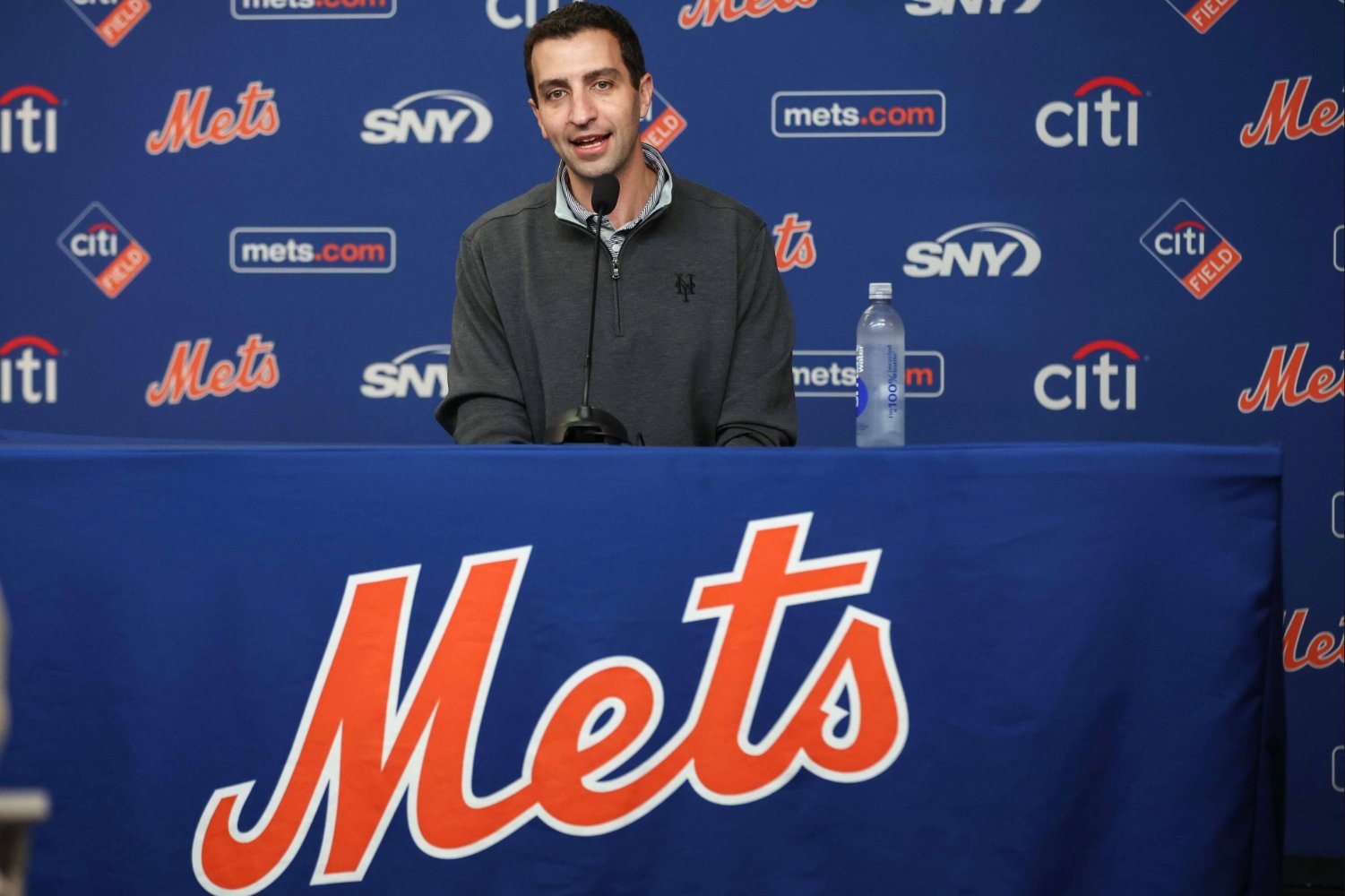
The thing is, Mets fans didn’t stop at a nice little ovation during his first plate appearance. They hoisted signs fit for Beatle-mania, booed when he was walked, and cheered so hard following a game-tying home run in the ninth inning that he, a visiting player, was granted a curtain call. But underneath the surface of this well-deserved love fest, another side came out. Alonso, who departed last fall in free agency, has come to embody fan resentment towards Mets’ President of Baseball Operations David Stearns.
David Stearns was always walking into a difficult situation when he took over the Mets in the fall of 2023. His work in Milwaukee, where he built a perennial playoff machine with limited financial resources, gave him an aura of invincibility, and Mets owner Steve Cohen’s insistence on spending aggressively to chase a World Series raised expectations to a point where failure was always the most likely outcome.
While not saving the Polar Bear has become the avatar of fan angst towards Stearns, the original sin was Cohen’s brash, unapologetic stance toward spending. Payroll is a superpower in baseball, but it isn’t a panacea. And while Cohen has spared no expense on the roster since taking over in 2020, it created an urgency for success that was antithetical to Stearns’ work in Milwaukee. In theory, bringing an executive so skilled at squeezing the most out of modest budgets and a firehouse of finances together seemed like a match made in heaven. But in practice, it’s a bit of oil and water.
This isn’t to absolve Stearns of his work, but it is important context. He made his mark by creating an organizational infrastructure capable of continuously spitting out competent major league talent, which Milwaukee is still benefitting from, and then he was thrust into a win-now situation. As they say, Rome wasn’t built in a day, but after three seasons, it’s fair to ask: has Stearns laid the groundwork for the behemoth Mets fans were promised, or will the barbarians sack the city?
B.S. (Before Stearns): 2023
Front offices are never granted a clean slate. Whatever messes the previous regime made, they have to clean up or wait out. The 2023 Mets followed up a 101-win campaign with a 75-87 stinker. They had the third-oldest average position player age (28.9) and the oldest pitcher age (31.9) in the National League. Simply put, Stearns inherited a morbidly expensive, geriatric roster that would need time to fully be flushed out.
To make matters worse, the Mets’ signings of Justin Verlander and Max Scherzer to massive short-term deals followed them into 2024. In an effort to land better prospects when pulling the plug on 2023, the Mets paid down a combined $59.16 million of the pair’s 2024 salary.
Upon taking the job, Stearns was saddled with an old, expensive roster, with some of its financial might tied behind its back, not to mention a mediocre minor-league system. It was far from an impossible situation, but the internal evaluation was almost certainly to tread water at the major-league level while the developmental infrastructure was built out.
2024: The Year Everything Went Right
Look, sometimes a plan goes horribly right. The Mets called 2024 a bridge year and acted like it. Their offseason saw them sign 12 veteran free agents ostensibly to one-year deals, plus a host more to minor-league contracts. The lone exception to the one-year pact plan was Sean Manaea’s two-year deal, but even then the second year was a player option. Stocking up on bulk arms (Manaea, Luis Severino), middle relievers (Jake Diekman, Adam Ottavino, Jorge Lopez), and veteran stop-gaps (Harrison Bader, J.D. Martinez) isn’t particularly exciting, but they’ll keep the lights on and the powder dry.
It shouldn’t be glossed over that the 2023-24 free agent class had Shohei Ohtani and Yoshinobu Yamamoto, which raises the question why the Mets weren’t more aggressive in their pursuit of true difference makers. Well, unfortunately, the Dodgers exist. They too have incredible financial resources, were coming off a 100-win season, and are geographically over 2,500 miles closer to Japan. The Mets were probably never seriously considered by either. That being said, the rest of the 2023-24 free agent class was pretty good.
Excluding Aaron Nola, the Mets could have targeted Cody Bellinger, Sony Gray, Blake Snell, Matt Chapman, Shota Imanaga, Seth Lugo, Josh Hader, and Jung Hoo Lee. All of them came with their own question marks, but they either signed for short-term deals or had annual average values under $20 million.
Unfortunately, the Mets’ lack of free agent fireworks didn’t doom them to a gap year. After a 22-33 start and a players only meeting, the Mets closed the season on a 67-40 run. They made the playoffs and then knocked off the Brewers and Phillies to make it to the NL Championship series where they would eventually lose to the Dodgers.
For a gap year, it was perfect, but not entirely. The Mets were clearly, obviously in the early stages of reorienting their roster towards the future, and 2024 made them look like they were on the doorstep of a title. However, they still had the second oldest average position player (30.0) and pitcher age (31.0) in the National League and benefitted from some pretty unsustainable fortune. Three of their five starting pitchers made 30-plus starts, the four who hit 20-plus starts all had ERAs that beat their FIPs, and they got a 3.0 WAR season from Jose Iglesias, who had signed a minor-league deal to bolster their depth. The problem with lightning in a bottle is it doesn’t stay there.
2025: The Start of the Collapse
The Mets entered 2025 as real contenders. They were coming off a fantastic run, returned a large chunk of the roster, added some guy named Juan Soto, and then got off to a fantastic start. On June 12, the Mets were 45-25, and looked poised to challenge the Dodgers for National League supremacy. Unfortunately, the wheels completely fell off from that moment on. They limped to a 38-56 finish, and missed the playoffs due to a tie breaker with the Cincinnati Reds.
The reason for their complete and utter capitulation is as varied as it is mysterious, but a lot of it came down to bad luck. They had the run differential of an 86-76 team, and finished the season with the sixth-best position player WAR (28.1), tenth-best pitcher WAR (17.1), and fifth-best overall WAR (45.2), according to Fangraphs. Wins above replacement (WAR) has a very strong correlation to wins, hence the name, and the Mets underperformed their underlying production by a massive margin.
Among teams with 40+ total team WAR, the lowest win total, excluding the Mets, were the Red Sox’s 89. Using a linear forecast model, the Mets underperformed their expected win total, based on WAR, by -8.6, the second largest underperformance in the league. Simply put, the front office built a very strong team that got ravaged by the baseball gods.
|
|
|||||||
|
|
|
|
|
|
|
|
|
|
|
|
|
|
|
|
|
|
|
|
|
|
|
|
|
|
|
|
|
|
|
|
|
|
|
|
|
|
|
|
|
|
|
|
|
|
|
|
|
|
|
|
|
|
|
|
|
|
|
|
|
|
|
|
|
|
|
|
|
|
|
|
|
|
|
|
|
|
|
|
|
|
|
|
|
|
|
|
|
|
|
|
|
|
|
|
|
|
|
A common refrain you’ll hear fans say when a team underperforms their underlying metrics is you can’t build a team in a spreadsheet. To that I say, “You only say that when things go wrong.” Every MLB team is built using statistics. Sometimes things go wrong, sometimes things go right, but baseball is an exceedingly random sport played on the finest of margins. The 2025 Mets were just a casualty of uncertainty, but 2026 has been a whole different ballgame.
2026: The Year Everything Went Wrong
Giving the front office a mulligan for 2025 would be appropriate. The team was legitimately good, and in most worlds they coast to the playoffs. Unfortunately, the 2026 team has actually been awful, and few of Stearns' offseason moves have worked out.
The signing of Bo Bichette has been an unmitigated disaster, Marcus Semien looks as cooked as burnt toast, and Pete Alonso has been exceptional in Baltimore. These three decisions have completely colored Stearns' tenure, but it’s probably not fair to say they were all bad ideas.
First and foremost, Bichette’s struggles came completely out of nowhere. He has a career wRC+ of 118, was coming off a season with a wRC+ of 134, and was entering his age-28 season. Every team, finances permitting, would have signed him to that exact same three-year, $126 million deal the Mets did. His second-half wRC+ of 110 offers hope that should he exercise his player option the Mets will have the player they thought they signed.
Trading Brandon Nimmo for Semien, and subsequently offloading Jeff McNeil, was about cleaning up the present and future of their finances while offering an opening for their young outfielders.
|
|
|
|
|
|
|
|
|
|
|
|
|
|
||
|
|
|
|
|
|
|
|
|
|
|
|
|
With Nimmo out of the way, the Mets were able to promote Carson Benge—more on him later—and it also opened an avenue for A.J. Ewing in center. The hope that Semien still had something in the tank was a real risk, but his deal will be much more palatable to move or eat than Nimmo’s would have been.
Unfortunately, letting Pete Alonso walk and replacing him with Jorge Polanco and the hope that Mark Vientos would stop being Mark Vientos has been an actual disaster. Committing $155 million to a first base, bat-only slugger entering their age-31 season is scary. The list of generationally awful contracts that have gone to players in that mold is a who’s who of regret: Albert Pujols, Miguel Cabrera, Chris Davis, and Ryan Howard, to name a few.
On its face, Stearns decision is defensible, but the way it has played out has been about as bad as possible. Alonso has been fantastic this season, Polanco has either been injured and/or awful, and Vientos’ fantastic 2024 is looking like a total fluke. By the end of Alonso’s deal, Stearns will probably look vindicated, because he didn’t balk at $31 million in 2026, he balked at $31 million in 2030, but he’ll have to make it that far.
Over Stearns' first three seasons at the helm, the on-field product has actually been solid. The problem is the implied trajectory. Going from 89 to 83 to 69 (and counting) wins does not inspire confidence that he is improving the team. Of course, that fails to acknowledge that MLB organizations are about more than the big-league club.
The Hidden Rebuild
Stearns was fundamentally brought in to rebuild the Mets. The hope was he could overhaul the Mets’ amateur scouting and development systems, while the big-league club stayed competitive, but he faced two serious challenges. The first was that the team he inherited was incredibly old, and the second was that the Mets' top prospects from the previous regime have largely faltered.
Stearns has done an excellent job bringing the average age of the roster down. They were one of the oldest teams in the National League his first two seasons, but currently rank eighth in average position player age and fifth in average pitcher age. Considering the moves made at the deadline, there’s a good chance the team is even younger in 2027, and if it isn’t, that means veteran reinforcements.
|
|
|
|
|
|
|
|
|
|
|
|
|
|
|
|
|
|
The youth movement might be underway, but the stagnation of Brett Baty and Francisco Alvarez has set the Mets back substantially in the short term. When Stearns took over in the fall of 2023, Baty was entering his age-25 season and Alvarez his age-23 campaign. They were supposed to be the heirs to the rapidly aging core, but both have struggled to make an impact.
Since 2024, Alvarez has produced a total of 3.0 bWAR, at an average of 1.7 bWAR per 162 games, while Baty comes in at 4.3 for an average of 2.2 per 162 games. However, 3.0 of Baty’s bWAR came in 2025 alone, which means he’s been basically a replacement level player in two of the past three seasons.
The truth is most prospects, even top ones, don’t become MVPs and All-Stars, but Baty at one point had a 55 grade and Alvarez a 60. Their current production, in particular Alvarez’s, is running well short of those grades, and it temporarily collapsed the Mets’ bridge to the future.
This context is important because Stearns first draft was in 2024, which means few of his front office’s hand-picked players have had enough time to reach the bigs, except for one. The first pick Stearns made as the head of the Mets was Carson Benge, which seems to be working out pretty well. Time will tell about his other picks, but he has been able to build up the Mets’ farm system, without access to top tier draft picks.
|
|
|
||||||
|
|
|
|
|
|
|
|
|
|
|
|
|
|
|
|
|
|
|
|
|
|
|
|
|
|
|
|
|
|
|
|
|
|
|
|
|
|
|
|
|
|
|
|
|
*Fangraphs organizational prospect rankings and value. In 2026 they changed their prospect valuation model
The Mets have had a grand total of 11 picks within the top 150 since 2024, but have still managed to build and maintain a top-10 farm system. Part of that is down to the players he inherited, but they have done well in the international market, trades, and improved internal development. Stearns might not have drafted Nolan McLean, but he went from a third-round pick to the top pitching prospect under his watch.
All told, Stearns has brought in six of the Mets current top-10 prospects, and dramatically improved the stock of countless pitchers already in the organization. So, while the big-league club has underperformed, the rest of the organization looks far healthier.
The Blueprint and Finances
However, the real question probably isn’t: Does David Stearns deserve to keep his job? The question is: What was his job? If Stearns was brought in to try and win a championship right away, then he’s failed. However, if his job was to build the infrastructure to consistently churn out major-league talent, then everything appears to be on track.
That’s probably not a satisfying answer, but it’s the exact blueprint the Dodgers used to become the best team in baseball. They lost their cheap-o owners, brought in an Ivy league wiz to build an exceptional baseball development infrastructure, and then weaponized their financial resources to push them over the top.
It’s easy to forget due to their decade-long run of dominance, but it took the Dodgers eight seasons to finally win a World Series. And while they were a perennial playoff team from the jump, they did have one sizable advantage over the Stearns-era Mets: money.
When the Dodgers sold to Guggenheim Baseball Management in 2012, they had a payroll of $116.7 million, the ninth-highest in baseball, and over $100 million short of the Yankees' league-leading figure of $225.6 million. By 2013 (that’s one offseason for those that are counting) the Dodgers led baseball in payroll at $236.7 million. For as much as Cohen has talked about spending, and he has, Stearns never had the financial runway to completely remake the Mets' roster through cash.
|
|
|
|
|
|
|
|
|
|
|
|
|
|
|
|
|
|
|
|
Truthfully, any team with a $300 million payroll should always be a playoff quality team, which makes 2026 such a disappointing, near-inexcusable season. But Stearns has positioned the Mets to have a ton of resources to quickly rebuild the squad for 202, assuming MLB doesn’t get their wish with a salary cap.
Right now, the Mets have $267.7 million in guaranteed salary for 2027, which gives them over $70 million to add to the roster, should they maintain their current spending levels. The 2026-27 free agent class gets pretty thin after Tarik Skubal, but it is heavy on quality veteran arms. On top of that, the Mets’ long-term salary situation is pretty rosy.
The only guaranteed contracts on their books for 2029 are Juan Soto and Francisco Lindor, two future Hall of Famers. While this doesn’t include any of their young core, they’ll all still be going through the arbitration process, meaning the Mets will be serious players to add high-end talent for the rest of the decade. Contrast that with the Dodgers, who have $238.5 million committed to seven players who will all be well into their 30s in 2029.
While I completely understand the current fan sentiment towards David Stearns, it conveniently ignores all of the good he has done. The organization is in a much healthier place than when he took over. Their MiLB affiliates and development pipeline looks far better and their books are relatively clean going forward. Sure, he let Pete Alonso walk in free agency, but Alonso’s production wouldn’t have turned this team into a playoff team. Every front office makes mistakes. Stearns has made his. But he finally has the Mets looking like a sleeping giant ready to wake.





Recommended Comments
There are no comments to display.
Create an account or sign in to comment
You need to be a member in order to leave a comment
Create an account
Sign up for a new account in our community. It's easy!
Register a new accountSign in
Already have an account? Sign in here.
Sign In Now