


Mets Video
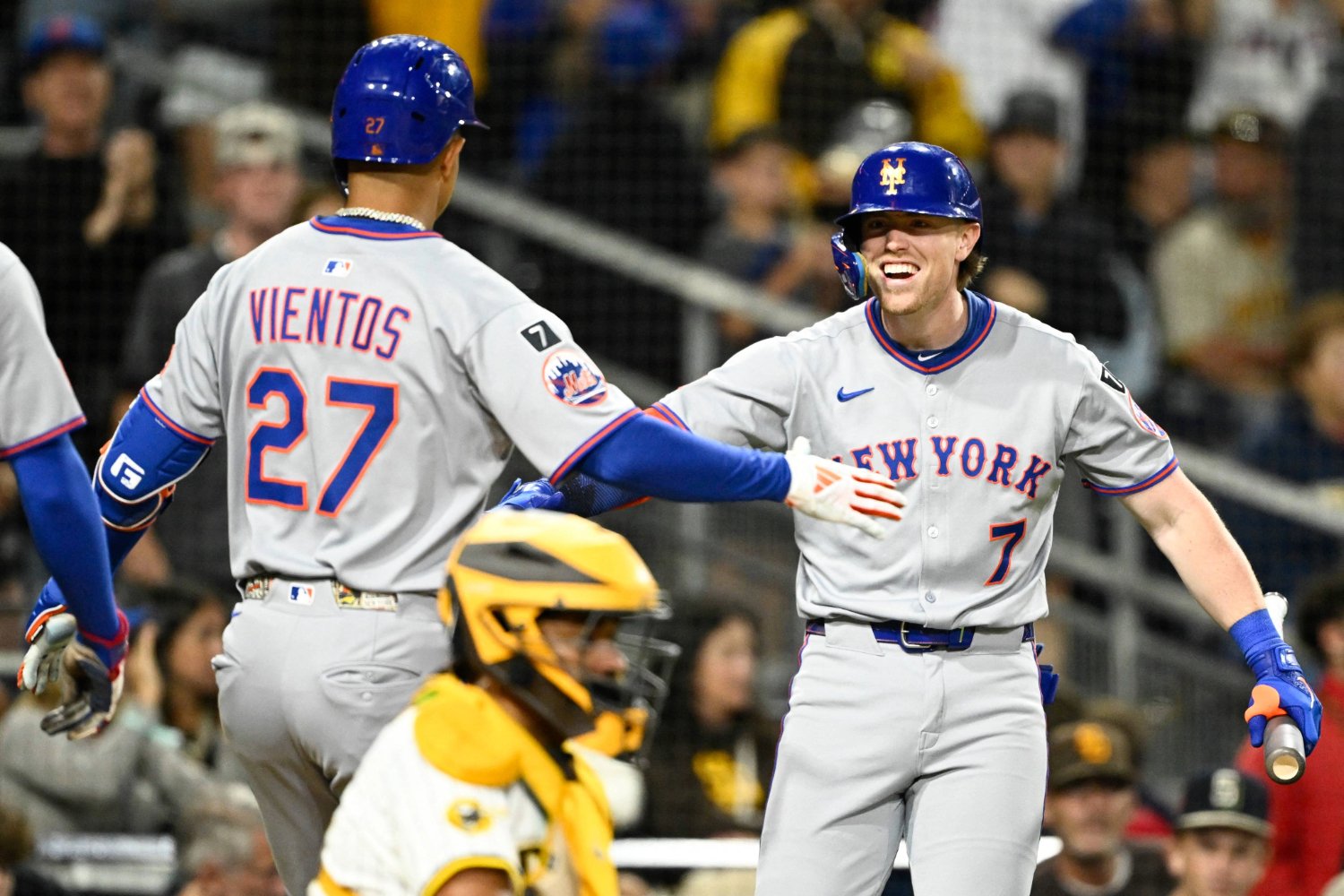
The nickname aged poorly. The "Baby Mets" -- Francisco Alvarez, Brett Baty and Mark Vientos -- have not matured into foundational players. There's an excellent chance the trio will be broken up in the offseason. Perhaps all three will go. This winter would be a good time for it to happen.
Baseball economics is a driver in that supposition. Alvarez, Baty and Vientos are all arbitration-eligible for 2027, and no matter what MLB's salary system will be after the lockout, shelling out low seven figures to veteran players who had respective bWARs of 0.7, 1.6 and minus-1.2 this year is not good business.
How long does the front office allow itself to be teased? How tightly should it hug these homegrown products? Team president David Stearns has shown that he isn't sentimental about players, and he inherited this lot to begin with.
On a human level, it feels like everyone could stand a change of scenery. All three players' careers have stalled after they've put in so much effort to improve. After this year's results, Stearns can't be certain that a breakthrough is coming. He started hedging last offseason when he shifted Baty and Vientos to bench roles in the aftermath of signing Jorge Polanco and Bo Bichette as free agents.
Let's dig into where the "Baby Mets" are falling short, and who could be next up to fill their spots.
Francisco Alvarez
Alvarez has the best chance of staying because of his position, but remember, his name was floated in trade rumors during the summer. Also recall the Mets signed Luis Torrens to a two-year, $11 million extension on May 2, and while there was a trend the past few years of teams paying good money for veteran backups, that still is a lot for a No. 2. But it's quite economical for a No. 1, and Torrens looked the part for much of this season (2.1 fWAR this season).
So, where is Alvarez lacking? To start, his focus on patching the down-and-away hole in his swing, with help from special assistant J.D. Martinez, has had an odd effect: his hole now is velocity. He improved from a .190 average against sliders and .152 against sweepers in '25 to .258 and .231, respectively, in '26, but he plummeted from .343 against four-seamers in 2025 to .231 in this year. That's more than statistical noise when each pitch has a decent-sized sample for both years.
GCM's Yirsandy Rodriguez has a full breakdown of how Alvarez has regressed at the plate and what it means for the Mets' catching situation going forward.
The defensive numbers remained mixed. His throwing has improved incrementally, according to Baseball Savant metrics, but he will never match Torrens' throwing ability. His framing took a hit in the first year of ABS challenges, and his blocking hit rock bottom at the first percentile.
His health history cannot be ignored, either. There was a thumb sprain in 2024, a hamate fracture and thumb UCL sprain in 2025, and a meniscus tear in 2026. Catchers take a pounding behind the dish, of course, but Alvarez's availability has been too limited. He has played in 100, 76 and 113 games in the past three seasons.
If Stearns feels he can only save money at the margins of the payroll, then he could finally go through with an Alvarez trade, give Torrens the majority of starts and sign a cheap, defense-first backup, ideally one who bats left-handed to complement the righty-swinging Torrens.
Brett Baty
Baty teased the front office again with another strong second half at the plate (.838 OPS, seven home runs in 49 games). The season-long bat speed (87th percentile) and exit velocity (73rd percentile) are tempting, as well. But a lack of progress against left-handers (.500 OPS, zero home runs in 91 plate appearances) and lackluster overall production (91 wRC+, 11 home runs in 143 games) signal he's just a platoon player.
A check of some Baty numbers paints a clear picture of why he hasn't broken through.
First, spin still vexes him. He couldn't figure out the sweeper, and so pitchers threw it more than ever to him this year. He posted a minus-4 run value on the pitch, with a .162 average and .216 slugging percentage. The slider was a problem, too, with a .167 average and .333 SLG (minus-1 run value). Those two deficiencies helped to cancel out the +3 run value and .446 SLG against four-seamers.
Second, despite the exit velocity and the 73rd-percentile launch angle-sweet spot percentage, the slug just wasn't there. His SLG dropped from a career-high .435 in 2025 to .371 this year. His extra-base-hit total remained flat (33 and 34 the past two years). After four-plus seasons in the majors, that's not a good sign.
And while he has the athletic ability to play multiple positions, he's not quite a glove-first player. His best work this year came at his natural position, third base, and it was modest. He registered +2 defensive runs saved (DRS) and +1 out above average (OAA). Among players with 450 or more innings at the position, he was tied for 14th in both DRS and OAA. He was a good-enough fill-in when Bo Bichette slid over to shortstop to cover for the injured Francisco Lindor.
Baty did show promise at second base, with +3 OAA and +3 fielding run value (FRV). The latter number was tied for 14th among all MLB second basemen. His work at first base and the outfield were limited, but not bad (2 DRS/-1 OAA at first, 2 DRS/-1 OAA in the outfield).
All of which is to say that Baty is versatile enough to keep but still a borderline call. The Mets enter the offseason with replacement utility options, starting with Christopher Morel, who has more power. They could finally give Ronny Mauricio a full season in the role, although he, too, might be on the outs after not getting a September call-up until Jared Young suffered a concussion and went on the injured list. They have deadline acquisition Emilien Pitre and waiver claim Christian Cairo at Triple-A as well, but Pitre probably needs more time there after a late promotion.
A club could do worse than to dream on a first-round draft pick who will turn 27 in November, and hope he finally figures it out to become a solid third baseman. Stearns should be making that pitch to interested parties about Baty over the next couple months.
Mark Vientos
Manager Andy Green was blunt about Vientos' future with the Mets when the club recalled the infielder from a minor-league rehab stint in late August.
"I still think there's a very bright future out there for him, if he wants to go grab a hold of it. That's on him," Green said. "When he gets back in the box, take advantage of the at-bats you do get and prove you deserve more at-bats."
Vientos got exactly 30 ABs in 12 games from Aug. 31 through Sept. 24. He homered twice and struck out eight times, or about what would be expected from him.
That sample doesn't forgive the entire 2026 body of work. The exit velocity, hard-hit rate, and line-drive rate all fell from 2025 despite fast bat speed. His ground-ball rate ticked up two points.
Also as you would expect from Vientos, the chase rate moved up as his season sputtered and frustration grew. To his credit, the whiff percentage ticked slightly downward. But in the end, we're talking about marginal statistical moves that landed within his career norms.
Therefore, Vientos' main value for 2027 and beyond, as Rodriguez noted last week for GCM, is as a platoon masher against left-handed pitching. But this is a player who showed two years ago that he could be more. Right now, he's just a guy who could maybe rotate with Polanco and Young.
Could a Vientos-Baty utility platoon play? The Mets would be pairing a 121 wRC+ against left-handers (Vientos) with a 103 wRC+ against right-handers (Baty) in that scenario, and maybe both would see a boost with more defined roles, but those numbers don't scream that it should be tried. In theory, Morel, Eric Wagaman or a cheap offseason pickup could fill the Vientos role and Mauricio can fill the Baty role.
Vientos still has trade value because his slug will entice a team to give him a fresh start. But will Stearns be reluctant to deal a player with 30-home-run power a year after letting Pete Alonso walk? Maybe, but Stearns saw Vientos struggle badly in the field at first base (minus-10 OAA), and run prevention is still important in Queens. And there aren't full-time DH at-bats available with Polanco, Juan Soto and even Lindor needing them.




Recommended Comments
There are no comments to display.
Create an account or sign in to comment
You need to be a member in order to leave a comment
Create an account
Sign up for a new account in our community. It's easy!
Register a new accountSign in
Already have an account? Sign in here.
Sign In Now